Core Internet Services (Part 1)
A vision for a cohesive, secure digital ecosystem: a synergistic suite of core internet services spanning accounting, data, finance, identity, and resources.
The Internet
Wikipedia defines the Internet as:
"the global system of interconnected computer networks that uses the Internet protocol suite (TCP/IP) to communicate between networks and devices."
The origins of this technology came from packet switching in the 1960s to further adoption by DARPA for resource sharing on military and academic networks. Widespread adoption of the Internet protocol suite in the 1990s led to the mass adoption of the technology we see today. Increased network connectivity options with cellular based networking has brought about a dependency on the Internet in the "first world" similar to that of water and electricity. It aids the modern citizen in everything from navigating, learning new things, and entertainment.
This rapid mass adoption has resulted in many "bolt-on" solutions that make up the "online" experience today. Personal information is spread out redundantly in many different databases with no canonical source of truth, making it difficult to protect and keep up-to-date. Email which is inherently insecure has become the "modus operandi" for business communication. Banking has become increasingly digital, but the systems running it have proven to be far from infallible and many of the same frictions from before digital persist.
If one considers the automotive industry, where would it be today if the only protocol that was ever worked on was the engine? We would likely see very fast, very unsafe cars. To the benefit of all, massive advancements in protocols for steering, suspension, braking, and passenger safety have shaped the industry and produce the vehicles we enjoy today. The internet has seen the same kind of continuous refinement, but almost entirely within one discipline. Its communication layers have evolved relentlessly, year after year, while the protocols the original design never included (for transacting, for accounting, for identity, for rights) were never built at all. Everything filling those gaps today is application-layer patchwork. The internet doesn't need an overhaul of what it does well; it needs the protocols it never had.
Core Internet Services
One approach to this would adopt a similar model to the automotive industry where a suite of synergistic services are purpose built to provide a cohesive and robust end-user experience. For the sake of this article let's call this suite of synergistic services Core Internet Services. To qualify as a Service in the suite the Service should provide a unique feature set as well as maintain the synergistic functionality with the other services that culminates in achieving the desired end-user experience. A break down of these services could look like the following:
Accounting
- General Accounting
- Temporal Ledgers
- Wallet Accounts
- Secure storage and signing
Data
- Databases
- File Systems
- Data Replication
- Message Queues
Financial Services
- Distributed ledgers
- Payment systems
- Registries
- Treasuries
Identity Services
- Authentication
- Authority and Authorization
- Profile Management
- Verification
Resources
- Allocation
- Billing
- Utilization
- Directory Services
Subsequent articles will dive into each of these services in detail, but for now let us consider how these functions are addressed in the current implementation of the internet.
Accounting
Current accounting systems retain the siloed nature from pre-Internet days. An ERP migration is rare in the life of any one company precisely because it is so expensive and risky (entire consulting practices exist to manage them), and between migrations, the everyday cost is integration: keeping siloed ledgers reconciled with banks, counterparties, and subsidiaries. Both costs are ultimately passed on to the consumer.
Opportunities exist to standardize on data models and communication protocols promoting interoperability, which would go a long way in reducing friction (which should result in cost reduction) in a reality where the end-user is far from siloed in their online interactions.
Data
A tremendous amount of data is unnecessarily stored redundantly (in use cases not considered backup or disaster recovery) across the internet. Data storage comes at a cost and unnecessary copies increase both maintenance and security costs. Canonical data sources with deliberate replication strategies as well as robust caching paradigms will be more cost effective, by increasing efficiency, providing resiliency, and reducing security control points.
Financial
One major thing Web 3 and cryptocurrencies have demonstrated to date is how friction can be reduced in markets and financial systems. Many types of transactions have been executed with the Smart Contract technology available today. But blockchains and hashgraphs, for all they have proven about disintermediation, still model a transaction as a moment: a balance changes at a block height. Most real-world agreements (leases, licenses, supply-chain terms, derivatives) are commitments over time, with rights and obligations that take effect in the future. Temporal event stores are built to record exactly that, which is what will enable the automation of more and more real-world contracts: reducing the need for middle-men, increasing speed, and ultimately reducing friction and cost.
Identity
Probably the biggest downfall of the current internet is the exploitation of end-users' information whether it's being bought and sold without consent (or even awareness), or actively used against them. Back to canonical data storage, end-users should be sovereign over their private data with the ability to store it in a trusted execution environment and backed up in locations of their discretion. Metadata associated with end-user private data (behavior, interest, location) should be shared only at the users discretion and when used for monetization, the end-user should be the benefactor of that value.
Resource
There is a tremendous opportunity for both businesses and individuals to leverage latent computer assets to support the functional demands of the New Internet. The benefit of doing so will reduce cost and friction by minimizing dormant assets, and moving many operations to "the edge" increasing efficiency. This strategy is also the most effective strategy to reduce the impact of computer based technology on the environment: it reduces over production and requires less redundant hardware, which ultimately lowers power consumption, resource extraction, and waste.
Related Posts
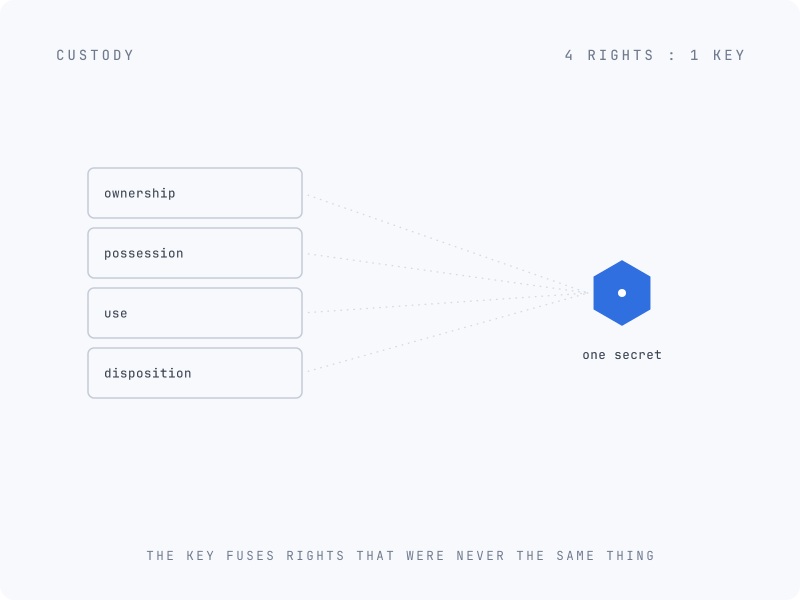
Custody Was Never About the Key
A firmware flaw let attackers guess the keys to thousands of hardware wallets without ever touching them. The people who lost funds did self-custody exactly right. The lesson is not that self-custody is foolish or that custodians are safer. It is that reducing custody to possession of a single secret throws away everything custody is actually made of.
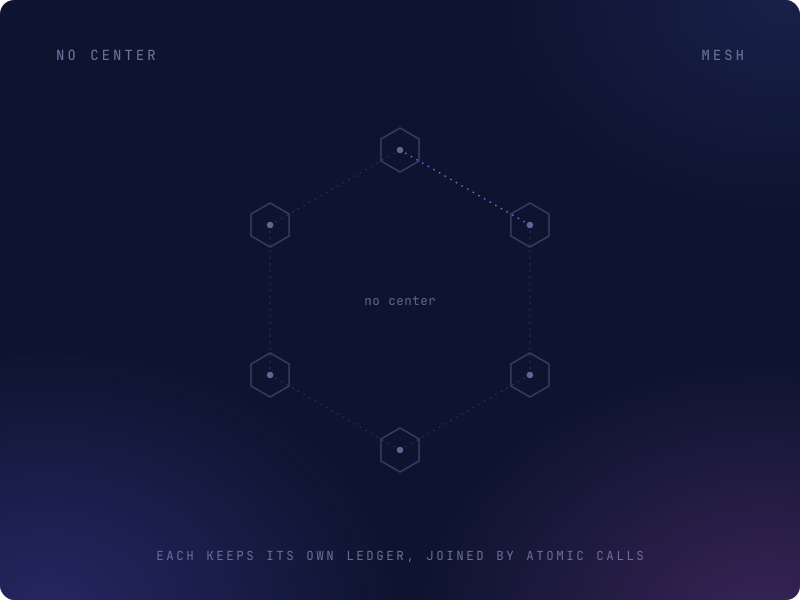
Does the Future of Money Need an Operator? A Third Answer.
Visa says the future of money still needs a trusted operator in the middle. Crypto says it needs global validator consensus instead. Both are answering the wrong question.
Conduit OS: Secure Appliance Infrastructure for the Conduit Network
How Conduit OS delivers a hardened, attestable operating environment for appliance operators, enabling verifiable compute across financial services and public sector deployments.