The Industry Solved Settlement and Called It the Whole Transaction
A commercial transaction has five parts, and nothing has really moved until all five are true. The digital asset industry spent more than a decade solving one of them, did it well, and then started using the word settlement as if it meant the whole thing. The other four are still open, and the reason is the same for each.
The token moved on Tuesday. The entitlement caught up on Wednesday.
That's a tokenized security changing hands, and it looks finished. The token moves in seconds, the transfer is final, anyone can see it, nobody's waiting on a batch file. Then look at the rights book, the register that says who actually holds the claim the token represents. It updates the next business day. On a holiday it doesn't update at all. For the gap in between, two systems that are supposed to describe one fact describe two.
I use that example because it's small, ordinary, and nobody involved did anything wrong. It's also, in miniature, the whole state of the industry. We've spent more than a decade and a great deal of money making one part of a transaction fast, and we've quietly started using the name of that one part as if it were the name of the whole.
A transaction is five things, and nothing has moved until all five are true
Strip any commercial transaction back to what has to be true for it to have actually happened, and I count five things.
- The agreement executes. Whatever the parties agreed, the thing that governs this transfer, has to be the thing that actually ran.
- Legal authority is enforced. Whoever caused the transfer had the right to cause it, under that agreement, at that moment, in that amount.
- The rights are recognized. The record of who now holds what claim reflects the transfer.
- Settlement occurs. The value moves.
- The books agree. Every party's accounting reflects what happened, not what somebody expects to have happened.
Five pillars: agreement execution, legal authority enforcement, rights recognition, settlement, and accounting sync. If any one of them is false, the transaction isn't done, whatever the screen says. A transfer that settled but wasn't permitted is a loss waiting for someone to notice it. A transfer that was permitted and settled but never reached the rights book is a dispute waiting for a reconciliation to surface it.
So the honest question isn't whether the industry has made transactions fast. It's where each of the five stands today, and who has actually solved it.
One out of five
Settlement is solved. I spend a lot of my time arguing with the digital asset industry, and none of that is a dismissal of its real achievement. Moving value quickly, with finality, between parties that don't trust each other, is a hard problem. The industry spent more than a decade on it. Nobody serious disputes that.
Now the other four, as they stand today.
Agreement execution is partially encoded at best. The agreement that governs the transaction is still signed somewhere off to the side, in a document, and the system that moves the value hasn't read it. Somebody read it and configured the system to approximate it, which is a different thing.
Legal authority enforcement is real-time in places, and the scope of the authority isn't provable. A system can check that a key is valid and that a role is assigned. What it can't do is hand you the clause. Ask it which sentence in which agreement gave this party the right to move this amount today, and it has nothing to show you.
Rights recognition is the example I opened with. The token moves in seconds. The rights book updates the next business day and fails on holidays.
Accounting sync is end-of-day batch, or a person typing it in. On-chain state doesn't update anyone's books. Every institution that touches the transaction enters it into its own ledger, on its own timing, by its own process, and compares notes later.
One pillar out of five. The industry solved settlement and started calling it the whole transaction. I understand why. Settlement is the pillar you can see, the one with a timestamp and a block number, and the one that used to be slowest. But a transaction that settled in seconds and is still waiting on four other things hasn't become fast. It's become fast in one place and exactly as slow as before everywhere else, and the four slow places are now where the risk lives.
The four are open for the same reason
Why are those four still open? It's one reason, not four.
An agreement is a document, and a document can't act. It can say what should occur. It can't make anything occur, check whether something was permitted, update a register, or post an entry. So every institution runs a second system, made of people, to do what the document can't do for itself. Lawyers draft it and read it. Operations staff carry it out, translating clauses into configurations and procedures. Auditors check afterwards that what happened matched what was agreed.
Notice when that last part happens. Afterwards. The document says what should occur, the money moves separately, and somebody reconciles the two later. Every one of the four open pillars is a place where the document and the execution are two different objects, kept in step by hand, on different clocks. The agreement is off to the side because a document can't execute. Legal authority isn't provable because the grant lives in prose and the permission lives in a system, and nothing binds them. The rights book lags because it's a separate record, updated by a separate process. The books disagree because each is a separate copy of a fact that nobody holds in one place.
That gap, between what was agreed and what actually happened, is the place a loss can hide. Not the only place a loss can occur; a counterparty can default, a price can move. But the place one can hide, undetected, until an audit or a dispute or a regulator asks the question that makes it visible.
Nobody has measured that gap directly, but one twenty-year review of fraud and error loss measurement, from Crowe and the University of Portsmouth, puts losses above five percent of expenditure, and past five trillion dollars a year when applied to world output. Fraud is the part of the gap that gets measured, which is why I treat the figure as a floor rather than a bill. It counts none of the people employed to prevent loss, and none of the capital sitting still while they work.
What comes from counting to five
If settlement is one pillar of five, then making settlement faster has a ceiling, because the other four pillars don't move when the first one does. The next order of improvement doesn't come from a faster chain. It comes from the four pillars that are not optimized, and those four are not optimized for a single reason: the agreement is a document, and a document can't act.
At Conduit, we start from the other end of that sentence. The way we build it, the agreement is the thing that executes: the thing the parties signed is also the thing that checks the legal authority, recognizes the rights, and posts the entries. Do that, and the four pillars stop being four separate systems kept in step by hand. They become properties of one operation. I'm not claiming the hard part is easy (getting an agreement into a form a machine can run faithfully is most of the work, and I'll write about what it takes later). I'm claiming it's the right problem, and that a faster chain isn't.
For now, the useful exercise is the count. Take any transaction your institution runs and ask, for each of the five, whether it's true at the moment the value moves or true at some later point when a person makes it so. For most transactions in most institutions, the answer is one out of five at the moment of the transfer, and four out of five by the end of the next business day, if nothing went wrong.
Settlement was never the whole transaction. It was the part we could see.
Related Posts
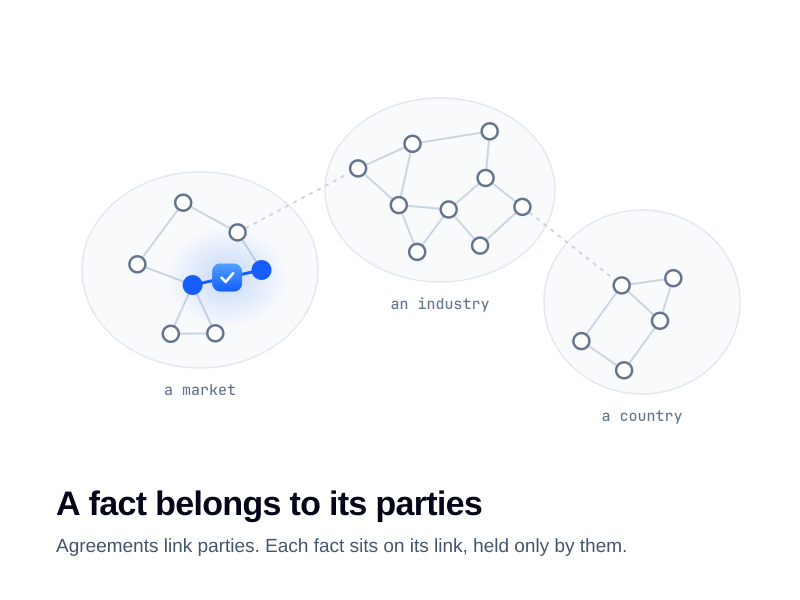
A Graph of Graphs, Not a Chain
The word ledger has come to mean one sequence of everything, agreed by everyone. But almost no fact in commerce is everyone's business. A record should be agreed where it belongs, among the parties to it, and the shape that produces is not a chain. It is a graph of graphs.
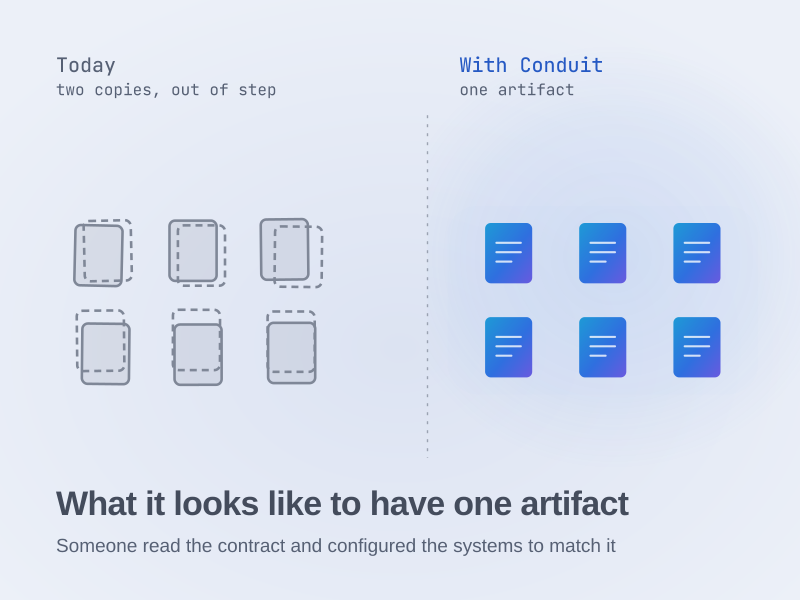
The Contract Says One Thing. Your Systems Do Another.
Every commercial relationship starts with an agreement and a set of systems that are supposed to carry it out. They begin aligned and then, quietly, they drift. Most of what is expensive and contentious in business lives in the gap between what was agreed and what actually executes.
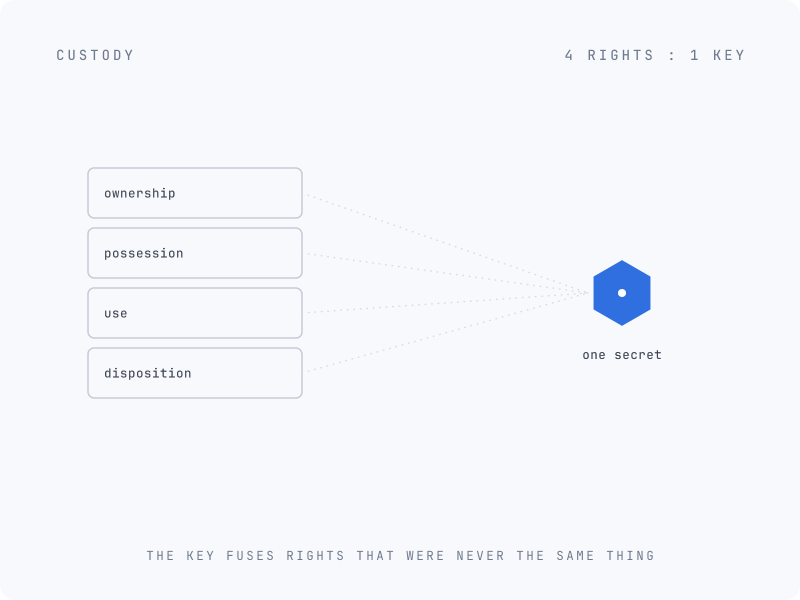
Custody Was Never About the Key
A firmware flaw let attackers guess the keys to thousands of hardware wallets without ever touching them. The people who lost funds did self-custody exactly right. The lesson is not that self-custody is foolish or that custodians are safer. It is that reducing custody to possession of a single secret throws away everything custody is actually made of.