How Cybersecurity Gaps in Layer-One Crypto Networks Threaten Real-World Asset Tokenization
Why the cybersecurity posture of many layer-one networks falls short of enterprise finance standards, and what that gap means for tokenizing real-world assets at scale.
As the world of finance edges closer to integrating blockchain technology into its core operations, the tokenization of real-world assets (RWAs) on layer-one (L1) networks has emerged as a potential game-changer. From real estate and commodities to traditional equities and bonds, the ability to represent physical or regulated financial assets as digital tokens on a public blockchain promises unprecedented efficiency, liquidity, and accessibility. Yet, as these ambitions move from theory to practice, an uncomfortable truth becomes evident: the cybersecurity posture of many L1 networks falls woefully short of the rigorous standards demanded by enterprise-grade finance.
At the heart of this fragility lies a confluence of factors, ranging from the absence of NIST and FIPS-certified hardware components to a general lack of industry-wide security frameworks and real-time threat monitoring. In a world where billions of dollars' worth of tokenized real estate, gold, or financial instruments could be at stake, the legacy "crypto-native" security model is simply insufficient. The stakes are no longer limited to "internet money." Mismanagement or exploitation of these vulnerabilities could trigger broad financial market disruptions, legal liabilities, and a serious erosion of trust in these emerging systems.
The Transition from Internet-Native Assets to Real-World Assets
When blockchains first emerged, the assets at risk were purely digital: cryptocurrencies and tokens that, while valuable, existed primarily within the blockchain realm. Today, however, L1 networks are increasingly hosting digital twins of real-world assets: tokenized real estate shares, regulated securities, carbon credits, precious metal reserves, and more. As traditional institutions wade in, compliance and security expectations rise dramatically.
In conventional finance, operational and custodial security adhere to well-defined industry standards and government regulations. Institutions rely on validated cryptographic modules, thorough audits, and continuous network defense systems to protect the integrity of markets worth trillions of dollars. Once these organizations begin anchoring asset representations on blockchains, they carry the same expectations: NIST and FIPS certifications for cryptographic hardware, intrusion detection systems, multi-tiered access controls, and stable operational security frameworks.
Absence of NIST and FIPS-Rated Cryptographic Hardware in Decentralized Nodes
A key element underpinning trust in financial systems is the secure generation, storage, and use of cryptographic keys. In traditional regulated environments, these keys are often safeguarded by Hardware Security Modules (HSMs) certified to stringent NIST and FIPS standards. Such certifications ensure the hardware has been rigorously tested against known attacks and meets stringent security and tamper-resistance criteria.
Yet, most L1 nodes today operate on generic cloud instances or commodity hardware, with no guarantee of secure key storage. Validators, miners, and node operators, who secure and maintain the consensus of the blockchain, often rely on consumer-grade computers, virtual machines, or hardware without any cryptographic certification. This discrepancy is more than a technical footnote; for institutions looking to tokenize and trade real-world assets at scale, entrusting settlement finality and asset custody to uncertified, potentially vulnerable hardware can be a show-stopper.
Real-World Asset Tokenization Attack Scenario
Imagine a major financial institution has chosen a popular L1 blockchain to tokenize high-value real estate holdings worth billions. The tokens, representing partial ownership interests, are held in custody accounts managed by institutionally run validators hosted on a major cloud provider. Without certified hardware, these validator machines handle private keys and sign critical transactions in a standard virtualized environment.
A sophisticated attacker who manages to exploit a newly discovered hardware-level vulnerability, similar to past exploits like Spectre or Meltdown, could infiltrate the underlying physical host machine. By carefully monitoring cryptographic operations and memory states, they extract the validator's private keys. With these keys in hand, the attacker can manipulate transaction ordering, engage in fraudulent transfers, or even facilitate a subtle double-spend. The result: a direct compromise of real estate asset ownership on-chain, with real legal and financial implications. Such an event could cause a crisis of confidence, legal disputes over asset claims, and severe reputational damage.
Inadequate Cybersecurity Monitoring and Threat Detection
In traditional finance, the security perimeter is bolstered by Security Information and Event Management (SIEM) systems, Intrusion Detection Systems (IDS), and real-time threat intelligence feeds. Financial institutions have entire departments dedicated to monitoring suspicious activity, rapidly isolating compromised systems, and neutralizing threats.
L1 blockchains, in contrast, lack centralized authority to mandate uniform security measures, and node operators rarely employ enterprise-grade monitoring. Without shared intrusion detection protocols, suspicious behavior, be it eclipse attacks, man-in-the-middle exploits on validators, or latency-based manipulations, can go unnoticed. By the time anomalies are detected, attackers could have already siphoned off significant value or manipulated the blockchain's settlement layer, impacting tokenized RWA markets.
A fair objection is that this is exactly what consensus is for: a node that misbehaves at the protocol level, by proposing an invalid block or signing a conflicting state, is detected and rejected by the next block producers or hashgraph witnesses. Consensus deliberately moves security from hardware to algorithm, and within its domain it works. But consensus validates signatures, not signers. A validator whose keys have been extracted signs transactions that are cryptographically indistinguishable from legitimate ones, and nothing in the protocol will ever flag them. The gap is not invalid state transitions going unnoticed; it is compromised infrastructure acting entirely within the rules. In a scenario where multi-billion-dollar securities are traded on-chain, detecting that class of threat is a compliance necessity, and it is precisely the class that consensus, by design, cannot see.
No Standardized Security Audits or Compliance Frameworks for L1
Compliance frameworks like SOC 2, ISO 27001, PCI-DSS, and financial regulations such as the SEC's cybersecurity guidelines exist for traditional financial entities. These frameworks ensure periodic audits, meticulous documentation of security controls, and continuous improvement.
L1 crypto networks lack equivalent comprehensive cybersecurity compliance standards. While some projects engage in voluntary code audits, these typically focus on protocol logic or smart contract vulnerabilities, not the holistic operational security environment: how keys are stored, how hardware is vetted, and how threats are detected and managed. This gap poses a major barrier for traditional institutions. They cannot merely trust the code; they need to trust the entire operational lifecycle: from key generation and validation node setup to threat monitoring and crisis response.
Without such standardized frameworks, regulated entities are left to assess each network's security posture piecemeal: possible, but expensive, bespoke, and hard to repeat across chains. The assessment problem also compounds a quieter one: transacting on a transparent public ledger exposes positions, flows, and counterparty relationships that institutions treat as trade secrets. Neither obstacle is fatal on its own, but together they add real friction to committing capital at scale.
Complexity, Responsibility Diffusion, and Real-World Consequences
Decentralized networks spread control, and thus responsibility, across countless participants. This structure can be a strength for censorship resistance, but it complicates the enforcement of security standards. No single entity can mandate that validators use certified hardware or implement intrusion detection. Economic incentives help maintain consensus but do not guarantee robust cybersecurity compliance.
For real-world asset tokenization, the stakes are higher. Traditional custodians, brokers, and asset managers are accustomed to clear regulatory requirements and understood responsibilities. A decentralized network without unified security standards can feel like a risky black box. The complexity of node software, consensus algorithms, cryptographic primitives, and networking layers only magnifies the difficulty of coordinating security best practices across a global, pseudonymous set of operators.
A security failure that results in the misappropriation or invalidation of tokenized real-world assets could lead to a cascade of consequences: legal disputes over on-chain asset ownership, insurance claims, regulatory crackdowns, and a loss of public trust in blockchain-based finance. The fallout could be severe enough to set back the tokenization movement by years.
Strengthening Key Management and Regulatory Alignment
In blockchain ecosystems, control of private keys equates to control of on-chain assets. For RWA tokenization, these keys represent substantial, tangible value. Their compromise can translate into real financial losses and legal liabilities. Yet, few L1 networks enforce standards for how keys should be generated, stored, rotated, or revoked. Traditional finance expects robust key management, using certified HSMs, multi-signature schemes, and strict access controls, to mitigate insider threats and external hacks.
Aligning on-chain key management with regulated financial norms is essential. Hardware-backed solutions, robust operational protocols, and regulated custody providers working directly with node operators can mitigate these risks. Without these improvements, large-scale RWA tokenization remains too risky for many regulated institutions.
A Roadmap to Secure RWA Tokenization on L1 Networks
Addressing these cybersecurity gaps will require concerted effort, industry collaboration, and a commitment to meeting the demands of institutional participation:
- Hardware Certification and Enforcement: Mandate or incentivize the adoption of NIST and FIPS-certified cryptographic hardware for validators and custody providers handling real-world assets. Protocol-level rewards or penalties could encourage compliance.
- Holistic Security Frameworks: Develop comprehensive, blockchain-specific security frameworks that mirror established compliance standards in traditional finance. These should cover not only code correctness but operational security, key management, and real-time threat detection mechanisms.
- Shared Threat Intelligence Consortia: Form alliances between blockchain projects, security firms, and regulatory bodies to share threat intelligence, indicators of compromise, and best practices. A community-driven approach can quickly identify and neutralize emerging attack vectors.
- Continuous Audits and Disclosure: Regular penetration tests, audits by reputable third-parties, and transparent disclosure of security reports can foster trust. These audits should measure the network's adherence to established security frameworks, providing a metric for institutional and retail participants alike.
- Aligning with Regulatory Expectations: Engage with regulators to craft guidelines that ensure on-chain asset tokenization aligns with the strictures of traditional finance. This could lead to formal attestations or certifications that a given network meets certain minimum cybersecurity standards, easing the path for institutional adoption.
The Future of RWA Tokenization Cybersecurity
The promise of tokenizing real-world assets on public, decentralized networks is profound. It could unlock new markets, increase liquidity, and streamline operations in countless industries. Yet, this vision cannot be realized if the cybersecurity foundations remain weak. Without certified hardware, robust threat detection, standardized auditing frameworks, and regulatory alignment, the dream of frictionless, trust-minimized asset trading will remain elusive.
By confronting these security challenges head-on, the blockchain ecosystem can usher in a new era of capital markets, one that blends the efficiency and openness of decentralized systems with the rigor and reliability of traditional finance. Only when L1 networks meet the stringent security requirements of institutional players will the full potential of real-world asset tokenization be realized.
Where the Conduit Network Fits
The gaps above are not a checklist to bolt onto an existing L1; they describe a network whose trust does not begin in hardware. The Conduit Network starts from the opposite end. Its atomic execution is anchored in FIPS-graded trusted execution environments at the Trusted Execution Layer, where the hardware enforces the boundary and the software conforms to the specification. There is no uncertified validator handling private keys in a shared virtual machine, because the substrate itself is the unit of trust: a Conduit-Compliant Appliance running the Conduit Software, attested before it is allowed to participate.
That hardware anchor enables a different data architecture, and the data architecture is the point. A transaction on the Conduit Network is not broadcast to a global validator set; it lives only on devices belonging to the counterparties of the agreement. Every actor on the network backs their participation with five Conduit-compliant devices, either hardware they host themselves or devices they rent capacity on. That gives each actor five-fold replication of their temporal ledger and computable data, and five-fold replication of computable execution. In a two-party agreement where both sides host their own devices, the agreement data and its ledger entries exist on a minimum of ten machines, every one of them owned by a party with a direct stake in the agreement's integrity. Counterparty devices validate each other, and because each is hardened, attested hardware, neither side can cheat the system it is validating. The result is privacy, security, and trust in the same design: no third party ever holds the data, no observer can mine the flows, and integrity is enforced by the counterparties' own silicon rather than by strangers' goodwill. This is a combination a public blockchain cannot offer, because its security model depends on giving everyone a copy.
That changes what a tokenized asset is. Rather than a token pointing at a legal document held elsewhere, an instrument on the Conduit Network is a rights graph: ownership, custody, transfer authority, and jurisdictional compliance governed by agreement state machines whose transitions are gated by authority proofs. Legal Authority, Agreements, and Rights Accounting commit as one atomic operation, so the question that breaks the scenarios above ("who held the keys, under what authority, and can they prove it?") is answered structurally rather than reconstructed after a breach. Audit becomes a query against an immutable event store, not a forensic exercise after the fact.
This is the difference between hardening a network that was never built for institutional value and starting from a substrate designed for it.
Related Posts
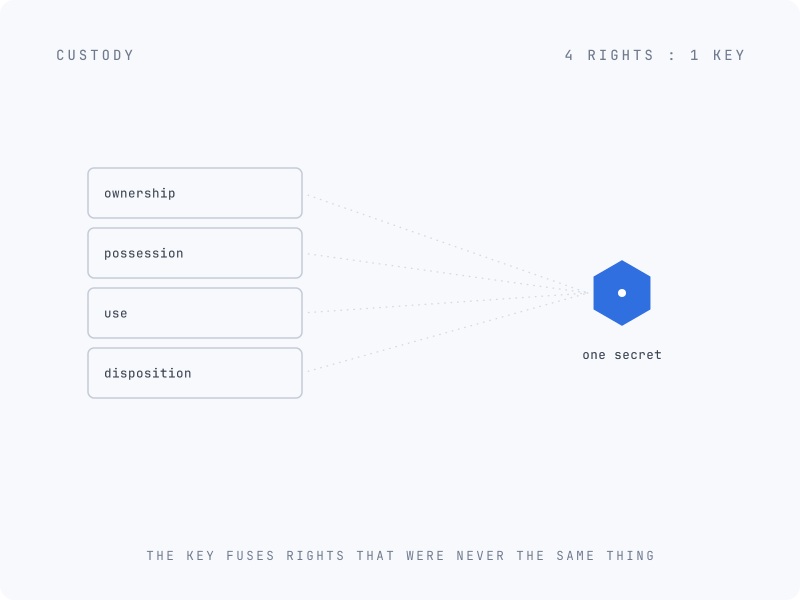
Custody Was Never About the Key
A firmware flaw let attackers guess the keys to thousands of hardware wallets without ever touching them. The people who lost funds did self-custody exactly right. The lesson is not that self-custody is foolish or that custodians are safer. It is that reducing custody to possession of a single secret throws away everything custody is actually made of.
Conduit OS: Secure Appliance Infrastructure for the Conduit Network
How Conduit OS delivers a hardened, attestable operating environment for appliance operators, enabling verifiable compute across financial services and public sector deployments.
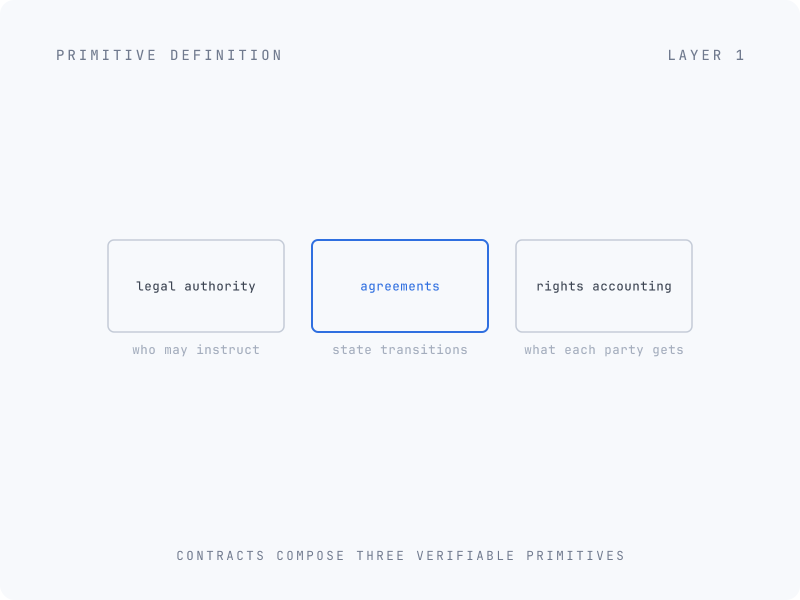
Computable Contracts: What Engineering Teams Need to Know
A technical introduction to Computable Contracts: how they differ from smart contracts, the primitives they expose, and how engineering teams integrate them into existing workflows.